Submitting a patch to GNU sed
I’m working on a long option parser
for Hare and decided to use sed as an example
(because Hare stdlib’s getopt has a sed example). This is sed’s man
page:
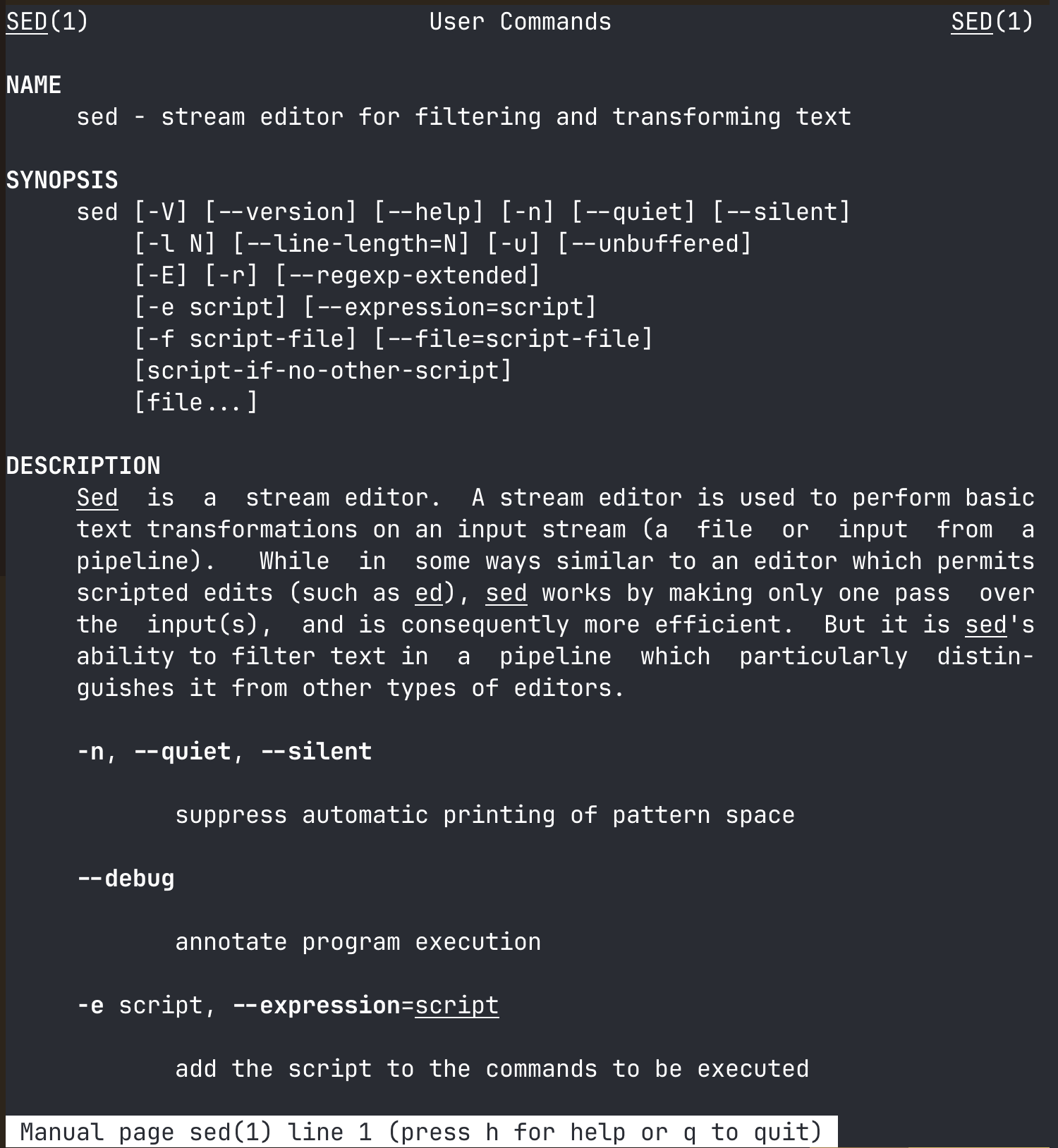
Zoom in..
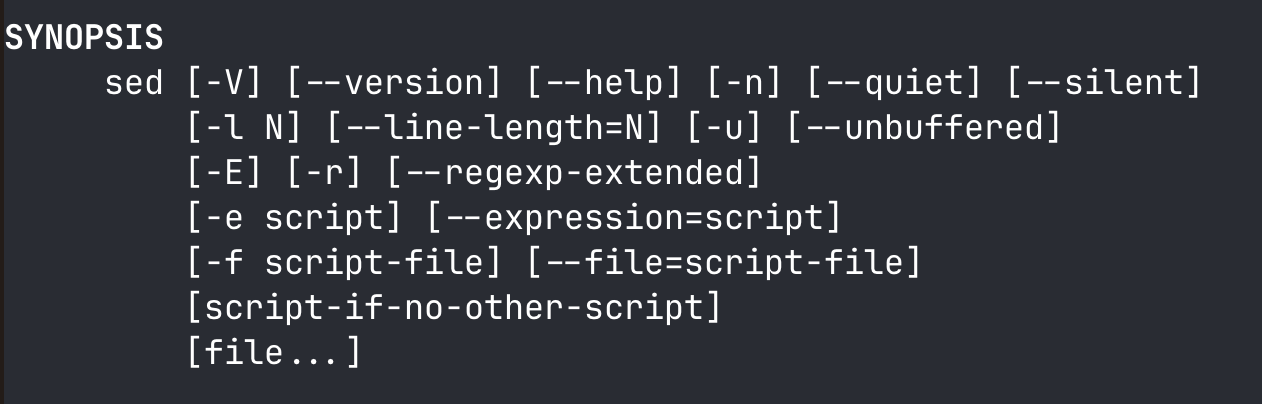
Enhance..
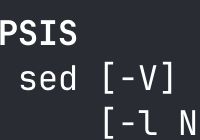
Huh, what does -V do?? It’s not described in the man page. Let’s try it.
» sed -V
sed: option requires an argument -- 'V'
Okay.. giving it a wut argument resulted in no error message and just the
usage text. So I found the GNU sed project page,
cloned the source, and found it really wasn’t doing anything. In fact, -V
used to be a version flag but it was removed in version 4.1 (released in
2004!).
So I made and submitted a patch for it! This is why I love open source software.
the patch itself
diff --git a/NEWS b/NEWS
index b5c768e..927743a 100644
--- a/NEWS
+++ b/NEWS
@@ -38,6 +38,10 @@ GNU sed NEWS                                    -*- outline -*-
   expression '.' cannot match an invalid multibyte sequence.
   [bug introduced in sed 4.2]

+  The undocumented '-V' option has been removed. sed now flags it as an
+  invalid option and no longer consumes a following argument.
+  [bug introduced in sed 4.1]
+

 * Noteworthy changes in release 4.10 (2026-04-21) [stable]

diff --git a/doc/sed.x b/doc/sed.x
index c1b1fcf..928f644 100644
--- a/doc/sed.x
+++ b/doc/sed.x
@@ -2,7 +2,7 @@
 sed \- stream editor for filtering and transforming text
 [SYNOPSIS]
 .nf
-sed [-V] [--version] [--help] [-n] [--quiet] [--silent]
+sed [--version] [--help] [-n] [--quiet] [--silent]
     [-l N] [--line-length=N] [-u] [--unbuffered]
     [-E] [-r] [--regexp-extended]
     [-e script] [--expression=script]
diff --git a/sed/sed.c b/sed/sed.c
index 3155dab..661edc2 100644
--- a/sed/sed.c
+++ b/sed/sed.c
@@ -189,7 +189,7 @@ specified, then the standard input is read.\n\
 int
 main (int argc, char **argv)
 {
-#define SHORTOPTS "bsnrzuEe:f:l:i::V:"
+#define SHORTOPTS "bsnrzuEe:f:l:i::"

   enum { SANDBOX_OPTION = CHAR_MAX+1,
          DEBUG_OPTION
The change itself is pretty simple but has been part of GNU sed for over 22
years! I also learned something new about optstring (via man 3 getopt). A
character followed by a single : is a required argument, but if it’s followed
by a double ::, it is an optional argument.
Also! W; makes -W foo equivalent to --foo! That’s wild!
I think most modern-day programmers are familiar with submitting changes to source forges like GitHub or GitLab, but GNU is a pretty old project and it’s not obvious how to do that. You actually have to send the change in via email!
You could do that by generating a patch file via git format-patch and pasting
the text into a standard email client, but the cool way is to send the email
directly from git. That’s right, git has builtin support for emailing
patches. Here is a beginner-friendly walk-through
of how to set that up. I also learned you can configure git to use a
credential helper to automatically
get the password from secure storage (like a password manager), which is what I
did too.
With all that done, I was ready to submit the patch:
» git send-email --to="bug-sed@gnu.org" HEAD^
OK. Log says:
Server: smtppro.zoho.com
MAIL FROM:<dev@miccah.io>
RCPT TO:<bug-sed@gnu.org>
RCPT TO:<dev@miccah.io>
From: Miccah <dev@miccah.io>
To: bug-sed@gnu.org
Cc: Miccah <dev@miccah.io>
Subject: [PATCH] sed: remove -V short option
Date: Wed, 11 Nov 2026 21:52:18 -0800
Message-ID: <20261112055218.54455-1-dev@miccah.io>
X-Mailer: git-send-email 2.54.0
MIME-Version: 1.0
Content-Transfer-Encoding: 8bit

Result: 250
🎉 #82228